Contents:
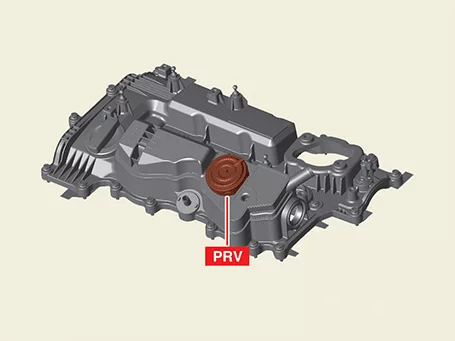
Crankcase Pressure Regulating Valve (PRV) Description and Operation
The Pressure Relief Valve (PRV) is installed to prevent the combustion gas from being accumulated in the
crankcase through the gap of the piston ring and increasing the pressure.
| 1.
|
Operating Principle
|
•
|
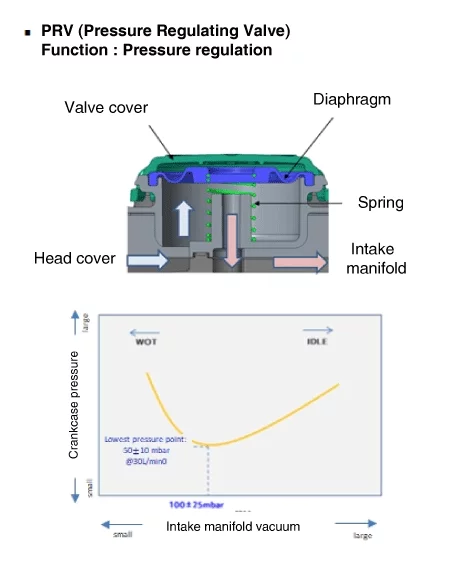
The PRV controls the degree of diaphragm closing by adjusting the intake
manifold vacuum, to
maintain the pressure inside the crankcase low (negative).
|
|
•
|
If the oil level gauge is removed, additional atmospheric air flows into the
intake manifold
through the PRV, based on the amount of blow-by gas created in the engine. As a
result, the amount
of actual intake air supersedes the amount measured by the sensor, which causes
hunting.
|
The oil level gauge is necessary during engine start.
|
|
|
| 2.
|
Advantage
|
•
|
A large amount of blow-by gas can be recirculated as the engine vacuum level
increases.
|
|
Engine Condition
|
Not Running
|
Idling or Decelerating
|
Normal Operation
|
Accelerating with high load
|
Vacuum in Intake Manifold
|
0
|
High
|
Moderate
|
Low
|
PCV Valve (Diaphragm)
|
Fully open
|
Slightly Open
|
Moderate
|
Open
|
Blow By Gas Flow
|
0
|
Small
|
Medium
|
High
|
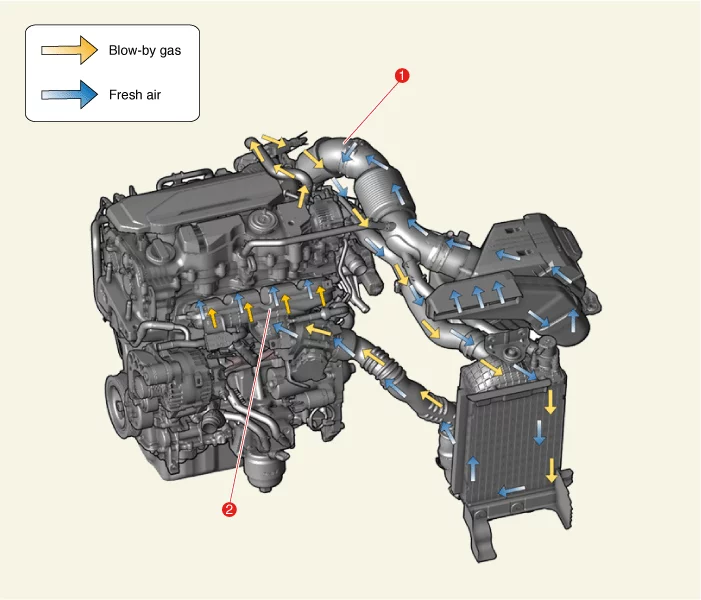
Schematic Diagram
|
|
| 1.
|
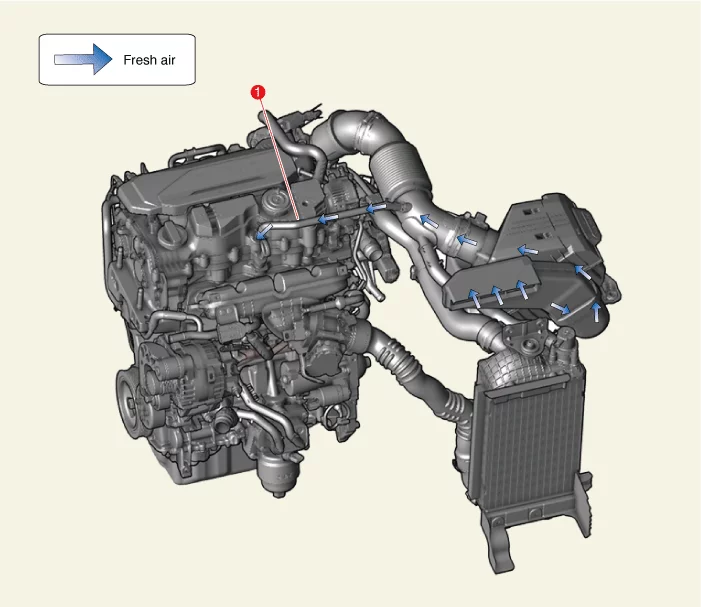
Clean air enters into the crankcase via the intake hose.
|
| 1.
|
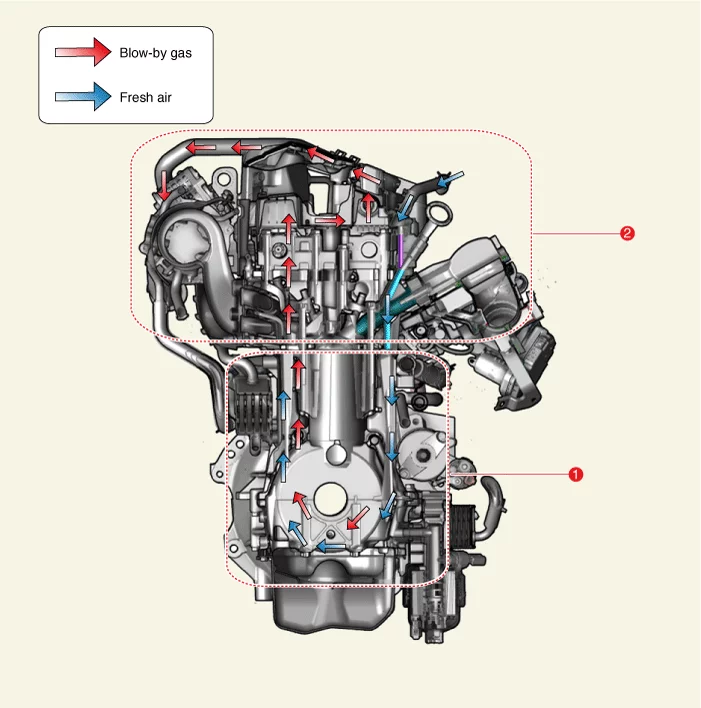
The blow-by gases are mixed with fresh air.
|
| 2.
|
The gas-air mixture is introduced into the cylinder head via the chain cover and cylinder
block.
|
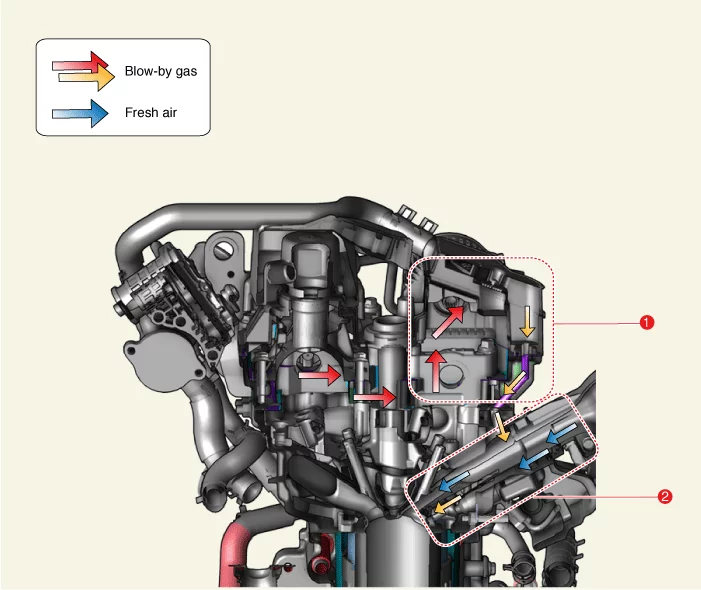
| 1.
|
The blow-by gases are introduced into the intake manifold via the PRV & breather passage
during the
full load operation.
|
| 2.
|
The blow-by gases are mixed with fresh air in the intake hose and intake manifold section.
|
| 1.
|
The blow-by gases are introduced into the intake manifold via the PRV passage during the
partial load
operation.
|
| 2.
|
The blow-by gases return to the combustion chamber to be burnt one more time.
|
Crankcase Pressure Regulating Valve (PRV) Replacement
|
Replace the cylinder head cover when the crankcase Pressure Regulating Valve (PRV) needs to be
replaced.
|
| 1.
|
Remove the cylinder head cover.
(Refer to Engine Mechanical System - "Cylinder Head
Cover")
|
| 1.
|
Install in the reverse order of removal.
(Refer to Engine Mechanical System - "Cylinder Head
Cover")
|
Other information:
Kia K4 (CL4) 2025-2026 Service Manual: Occupant Detection System (ODS)
Your new Kia K4 is equipped with an advanced Occupant Detection System (ODS) integrated directly into the front passenger’s seat to enhance safety during potential collision events.
The ODS in the Kia K4 continuously monitors the presence of a properly seated front passenger and calculates whether the passenger’s front airbag should be activated or deactivated.
Kia K4 (CL4) 2025-2026 Service Manual: Navigation-based Smart Cruise Control limitations
The Navigation-based Smart Cruise Control (NSCC) system is a highly advanced convenience feature; however, its performance relies heavily on accurate real-time data. The system may exhibit abnormal or unexpected behavior under the following circumstances:
The navigation system is experiencing a technical malfunction.
Map data fails to transmit correctly due to glitches in the infotainment system screen.