| Turbocharger Inspection Procedure |
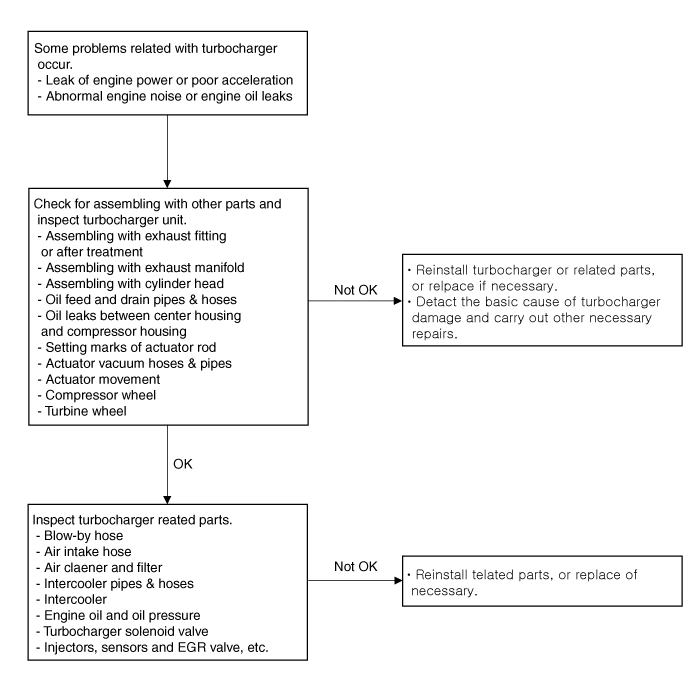
| In case of insufficient power, poor acceleration, noise, or oil
leakage,
check the turbocharger for abnormalities by following the procedure below. |
| 1.
|
Check the assembly between the turbocharger and the exhaust or aftertreatment unit.
|
–
|
Check the Gasket Assembly
|
|
–
|
Check the Bolt/Nut tightening
|
|
–
|
Check for Gas leakage
|
|
–
|
Check for damage such as cracks
|
If the gas leakage is caused due to the stuck gasket or bolt/nut tightening fault, noise and
oil leakage
can be caused while accelerating.
If there is a problem, check the tightening torque of bolt/nut again and tighten them to the
specified
torque. If needed, replace the gasket or damaged components with new ones.
|
| 2.
|
Check for assembling of the turbocharger and the exhaust manifold.
|
–
|
Check the Gasket Assembly
|
|
–
|
Check the Bolt/Nut tightening
|
|
–
|
Check for Gas leakage
|
|
–
|
Check for damage such as cracks
|
If gas leaks due to gasket adhesion or poor fastening of bolts/nuts, noise occurs during
acceleration.
If there is a problem, check the tightening torque of the bolts/nuts again, tighten to the
specified
torque and replace gaskets or damaged parts if necessary.
|
| 3.
|
Check for assembling of the exhaust manifold and the cylinder head.
|
–
|
Check the Gasket Assembly
|
|
–
|
Check the Bolt/Nut tightening
|
|
–
|
Check for Gas leakage
|
If gas leaks due to gasket adhesion or poor fastening of bolts/nuts, noise occurs during
acceleration.
If there is an abnormality, recheck the tightening torque of the bolts/nuts, tighten them to
the
specified torque, and replace the gasket if necessary.
|
| 4.
|
Check the turbocharger oil feed pipe & hose and oil drain pipe & hose.
|
–
|
Check the Gasket Assembly
|
|
–
|
Check bolted tightness.
|
|
–
|
Check the clamping state.
|
|
–
|
Check if the oil pipes & hoses are damaged (bent, crushed, torn or
cracked).
|
Leakage may occur due to gasket bonding or poor bolting.
If the oil supply pipe/hose is damaged, refueling of the turbocharger may not be smooth and the
turbocharger may be damaged.
If the oil drain pipe/hose is deformed and clogged, the oil may not drain smoothly and the
supercharger
may leak.
If there is an abnormality, check the tightening torque of the bolts and tighten them to the
specified
torque. If necessary, replace the gasket or damaged parts.
|
| 5.
|
Check for leaks between the turbocharger's central housing and the compressor housing.
|
–
|
Check bolted tightness.
|
If the "O" ring (gasket) between the center housing and the compressor housing is damaged, oil
will leak
from this area.
If there is a problem, replace the turbocharger.
|
| 6.
|
Check the turbocharger actuator.
|
–
|
If an electronic actuator fault diagnostic code occurs, perform an inspection
according to the
inspection procedure.
(Do not remove the electronic actuator unless a fault code occurs.)
|
|
•
|
Check the actuator's operability by forcing the electronic actuator with GDS.
|
|
•
|
If the electronic actuator needs to be replaced, replace it according to the
maintenance
procedure suggested by the turbocharger company.
|
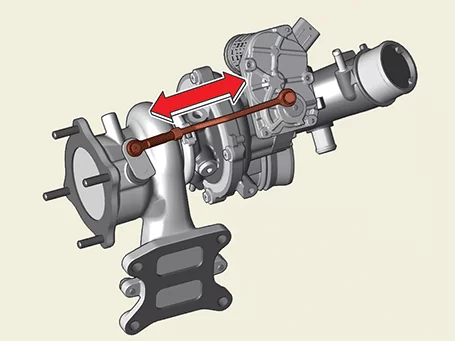
If the actuator is damaged, the engine power drops and there is no acceleration.
If there is a problem, replace the turbocharger.
|
| 7.
|
Check the condition of the compressor wheel on the turbocharger.
|
–
|
Condition of the wheel (bent or dented)
|
|
–
|
Whether the wheel rotates smoothly
|
ex)
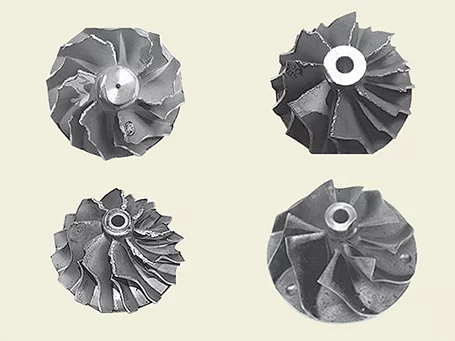
Damage to the blades on the compressor wheel causes the turbocharger to make noise and reduce
engine
power.
If there is a problem, replace the turbocharger.
|
| 8.
|
Check the condition of the turbine wheel on the turbocharger.
|
–
|
Wheel condition (damaged or not)
|
|
–
|
Whether the wheel rotates smoothly
|
ex)
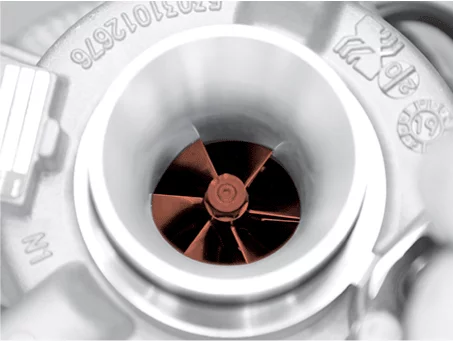
Damage to the blades of the turbine wheel causes the turbocharger to make noise and reduce
engine power.
If there is a problem, replace the turbocharger.
|
| If there is no abnormality as a result of the supercharger
inspection,
check the related peripheral parts as follows. |
| 1.
|
Check engine blow-by hose.
|
–
|
Breather hose condition (bent or clogged)
|
If the breather hose is bent or blocked, the internal pressure of the engine rises and the oil
supply to
the turbocharger is not smooth, which can cause damage to the turbocharger and oil leakage.
If there is a problem, replace the breather hose or related parts.
|
| 2.
|
Check the air intake hose upstream of the turbocharger.
|
–
|
Condition of air intake hose (bent, dented, missing or torn)
|
If the hose cross-section is reduced due to bending or crushing of the hose, the amount of air
going to
the supercharger decreases and the shear pressure of the supercharger drops, which may cause
damage to the
supercharger and oil leakage. If the hose is pulled or torn, debris can enter the turbocharger
and damage
the turbocharger wheels.
If there is a problem, replace the air intake hose.
|
| 3.
|
Check the air cleaner.
|
–
|
Air cleaner filter contamination
|
|
–
|
Water inflow from the air purifier filter
|
|
–
|
Air cleaner cover dirty condition
|
|
–
|
Whether genuine air purifier filter is used
|
If the air cleaner filter is wet or humid, the amount of air going to the turbocharger
decreases when
using non-genuine products, which lowers the turbocharger shear pressure, which may cause damage
to the
turbocharger and oil leakage.
If there is a problem, replace the air cleaner filter.
|
Please observe the replacement cycle of the air cleaner filter.
|
|
| 4.
|
Check intercooler hose/pipe.
|
–
|
Hose/pipe connections
|
|
–
|
Condition of hose (bent, broken or torn)
|
|
–
|
Check the pipe for damage such as cracks.
|
|
–
|
Check the clamping state.
|
If the intercooler hose or pipe is broken or disconnected, this may cause oil leakage or exceed
the
supercharger's allowable speed and cause the supercharger to break.
Replace the intercooler hose/pipe if there is a problem.
|
The clamp must be installed as new.
|
|
| 5.
|
Check the intercooler.
|
–
|
Condition of intercooler tube and tank (no leaks, cracks, etc.)
|
If the intercooler is damaged due to cracks, etc., the supercharger may be damaged by exceeding
the
allowable speed of the supercharger.
If there is a problem, replace the intercooler.
|
The clamp must be installed as new.
|
|
| 6.
|
Check engine oil.
|
–
|
Whether the oil level is adequate
|
|
–
|
Whether oil discoloration, moisture penetration, or reduced viscosity
|
|
–
|
Whether the specified grade of oil is injected
|
If the engine oil is low, the amount of oil flowing into the turbocharger is small, and the
turbocharger
bearings may burn out due to insufficient lubrication and insufficient cooling.
If there is a problem, add or replace the specified engine oil.
|
Observe engine oil change intervals.
|
|
| 7.
|
Check engine oil pressure.
|
–
|
Whether the engine oil pressure is adequate: After removing the oil pressure
switch, use the oil
pressure gauge to measure the oil pressure.
|
|
–
|
When the oil pressure drops, check the oil screen on the oil pan and check the
injectors for gas
leaks when there is dirt on them.
|
When the hydraulic pressure is low, the amount of oil flowing into the supercharger is small,
and
insufficient lubrication and lack of cooling can cause the supercharger bearings to stick.
If there is a problem, add or replace engine oil. If the oil screen is dirty, clean the oil
screen, check
the injector for gas leaks, and then replace the injector washer. If necessary, check engine oil
related
parts such as oil pump.
|
Oil abnormalities cause serious damage to the bearings of turbochargers
rotating at high speeds
above 100,000 rpm.
|
|
| 8.
|
Check the injectors, various sensors and valves.
(Refer to Engine Control / Fuel System - "Engine Control
System")
|
–
|
Injector operability such as fuel injection status
|
|
–
|
Operability of sensors such as air flow measurement sensor (MAFS), intake air
temperature sensor
(IATS), and boost pressure sensor (BPS)
|
If the injector, various sensors, valves, etc. are damaged and do not work or malfunction,
engine output
may decrease.
If there is a problem, replace the damaged part.
|
Other information:
Kia K4 (CL4) 2025-2026 Service Manual: Automatic transmission (shift lever)
The 8-speed automatic transmission in your Kia K4 is engineered to provide a sophisticated driving experience. By offering 8 forward gears and 1 reverse gear, the transmission of the Kia K4 continuously optimizes gear ratios to strike the perfect balance between fuel efficiency and responsive power delivery.
Engage the brake pedal and the mechanical lock release button when shifting gears.
Kia K4 (CL4) 2025-2026 Service Manual: Highway Driving Assist (HDA):
Highway Driving Assist
The Highway Driving Assist (HDA) system in your Kia K4 is designed to detect lane markings and lead vehicles. It actively assists in maintaining a safe following distance, adhering to your set speed, and centering the Kia K4 within its lane while driving on supported highways.